
October 28, 2026 · Dra. Fabiola Esther Flores Arredondo
Newborn eye screening: what it is, when to do it and why it matters
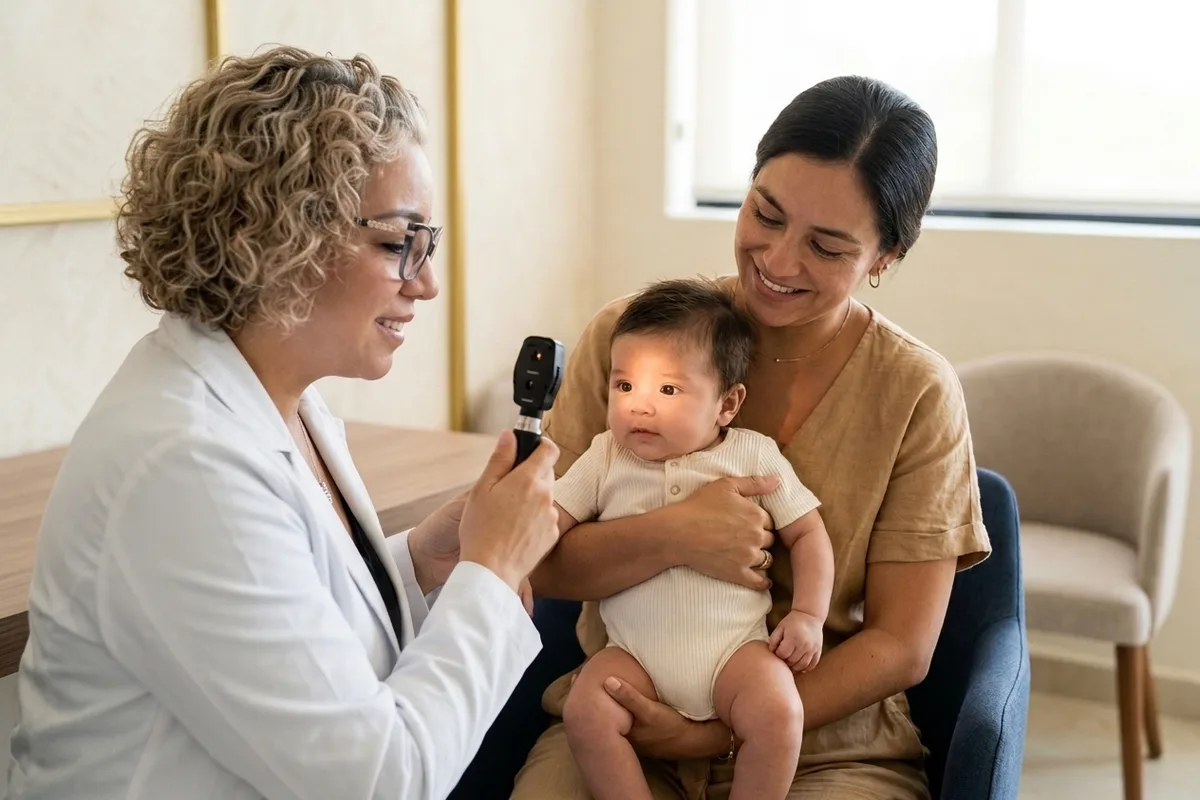
Short answer: newborn eye screening is an exam of your baby’s eyes that looks, from the first month of life, for conditions that can cause low vision or blindness if they are not treated in time. It is painless, takes about 40 minutes and, in Cancún, is performed by ophthalmologist Dr. Fabiola Flores for $1,500 MXN, including a written report. English spoken.
What is newborn eye screening?
It is a preventive exam of your baby’s eyes. Just as the newborn blood-spot test or the hearing screening look for problems that cannot be seen with the naked eye, eye screening checks that light can enter the eye and reach the retina without obstruction, and that the structures of the eye are healthy.
What does Mexican law say?
Mexico’s General Health Law (Ley General de Salud), article 61, includes newborn eye screening at four weeks after birth as part of maternal and child care, for the early detection of malformations that can cause blindness, and their treatment. In other words, it is not an optional extra: the law recognizes it as part of the basic care every newborn should receive.
Why do the first months matter so much?
Babies are not born seeing like adults: vision develops during the first months and years of life, as the eye sends clear images to the brain. If something blocks or blurs those images during this period, the brain does not learn to see well with that eye, and some of that loss can become permanent even if the problem is corrected later.
That is why timing matters. Finding a congenital cataract early, for example, allows it to be treated while vision is still developing. Waiting for the baby to “grow a little” or for an obvious sign to appear can mean missing that window.
And a baby cannot tell you they don’t see well. Many of these problems cause no pain and no visible changes for parents at first.
What can it detect?
Screening can reveal warning signs of:
- Congenital cataract: clouding of the lens present from birth, which blocks light.
- Congenital glaucoma: increased pressure inside the eye that can damage the optic nerve.
- Retinoblastoma: a rare but serious tumor of the retina, where early detection is key.
- Retinopathy of prematurity: abnormal blood vessels in the retina that can affect babies born early or with low birth weight.
- Corneal clouding, malformations and other conditions present at birth.
A warning sign does not always mean serious disease; it means it should be looked at carefully and in time.
What is the exam like?
Dr. Flores performs the exam personally, with your baby in your arms. It takes about 40 minutes:
- Medical history: questions about the pregnancy and birth, whether the baby was premature, and any family history of eye disease.
- External exam: eyelids, the shape and size of the eyes, the cornea and eye movements.
- Red reflex test: a soft light shows the reflection from the back of the eye. A red, even reflex in both eyes is a good sign; a white, dull or unequal reflex means further evaluation is needed.
- Dilated retinal exam: eye drops dilate the pupils so the retina and optic nerve can be examined in detail.
The exam does not hurt. At the end, the doctor explains the findings and, within 24 hours, you receive a written report by email or WhatsApp, useful for your pediatrician and your baby’s records.
When should it be done?
- From one month of age, in line with Mexican law (four weeks).
- If it was not done then, the sooner the better: it is never too late for a first exam.
- With special attention if your baby:
- Was born premature or with low birth weight. Dr. Flores also evaluates premature babies.
- Has relatives with childhood cataract, glaucoma or retinoblastoma.
- Was exposed to an infection during pregnancy or spent time in the NICU.
The hospital already checked my baby’s eyes. Should we still do it?
Many hospitals perform a general check at birth, which is very valuable. Eye screening with the specialist is a more detailed exam focused only on the eyes and including a dilated retinal exam. If you are unsure what was done, bring the hospital report to the visit and the doctor will advise you.
Warning signs parents can notice at home
Besides screening, see an eye doctor promptly if you notice:
- A white pupil or whitish glow, sometimes visible in flash photos instead of the usual “red eye”.
- Eyes that wander constantly, or unusual, repetitive eye movements.
- Constant tearing, strong sensitivity to light or a cornea that looks greyish or cloudy.
- One eye noticeably larger than the other.
- After 3 months, a baby who does not fix on or follow faces or objects.
These signs do not always mean something serious, but they deserve an eye exam without delay.
How much does newborn eye screening cost in Cancún?
Newborn eye screening with Dr. Fabiola Flores costs $1,500 MXN and includes the complete dilated exam and the written report.
The office is on Av. Tecnológico, Edificio Océanos, SM 503, Local 2 (inside Óptica EOX), in Cancún. Learn more about newborn and infant eye screening in Cancún or message us on WhatsApp at +52 998 601 8740 to book your baby’s exam.
Sources
- Mexico’s General Health Law, article 61 (Chamber of Deputies, in Spanish)
- American Academy of Pediatrics: Red Reflex Examination in Neonates, Infants, and Children (Pediatrics, 2008)
Price current as of October 28, 2026; please confirm when booking. This article is for educational purposes and does not replace a medical evaluation.
This article is informational and does not replace a medical consultation. Written and reviewed by Dra. Fabiola Esther Flores Arredondo, Ophthalmic Surgeon, Professional License #3872518.
Related service
Newborn Eye Screening